Pages

"And this is my prayer, that your love may overflow more and more with knowledge and full insight to help you determine what is best, so that in the day of Christ you may be pure and blameless, having produced the harvest of righteousness that comes through Jesus Christ for the glory and praise of God." -- Philippians 1:9-11

Wednesday, September 25, 2013

Monteverde

No testing has overtaken you that is not common to everyone.  God is faithful, and he will not let you be tested beyond your strength, but with the testing he will also provide the way out so that you may be able to endure it.”
~1 Corinthians 10:13

So I figured I should share a little of the town I am actually living in, and talk about what I am doing while in Monteverde.  Basically my semester here is broken up into sections that focus of different classes.  It is not a normal schedule by any means.  The field trips are very intensive, and we were all looking forward to coming to Monteverde for a break.  However that was not the case when we arrived.  Frequently I find myself feeling like this when we are assigned yet another essay or presentation and zero time to complete it…

Callicebud caquetensis

Beyond that overwhelming (and all too frequent) sensation, I am keeping busy and learning lots in a schedule jam packed with lectures, activities, and Spanish!  Class eight hours a day quickly wears you out, and homework and studying on top of that have all too often felt impossible.  Yet this too shall pass, and time keeps moving!  Now in just a couple days all our tests will be over and off to the second field trip we go!

Don't let all the pretty colors fool you...

On my first full day in Monteverde, I went into town to church with my friend Heather.  We weren’t really sure what to expect (or how to get there for that matter) and neither of us really spoke much Spanish.  However we made it just in time to see the circus roll into town.  I guess it was “Feliz dia des ninos,” happy kids day or something like that, and so a group from San Jose was up and leading activities for kids in the communities.  All the leaders were dressed up as clowns and farmers (and one farmer clown), and the kids danced and sang and jumped up and down praising God over and over again!  I suppose that was actually a good way for me to experience church in Spanish for the first time, as the children repeated phrases over and over again I began to pick up on a few words.


"Church of God Inc."

The next Sunday when we tired to go to church it was Independence Day, and the whole town was out in the streets celebrating.  When we got to church we found out that the service was moved to the evening so that everyone could go to the parade.

Kids from the schools preformed in the parade


Church that evening also included traditional dances, and it was so great to see the people here celebrating their country.  The message was about how we have been set free in Christ, and that is a gift that is to be celebrated!

One the school spectrum, classes have been going well.  Many of our activities are still very hands on.  We played with dirt last week to learn about characteristics of tropical soils in different ecosystems, and went insect hunting to learn about the inset orders (this lesson taught me that I need some more work with the butterfly net…) We have done various experiments and analysis on topics ranging from composition of the morphospecies of the lichen community to epiphyte presence on trees.  One day we went out and counted water striders in the stream all afternoon.  Field biology is much more wet feet than a lab that is for sure!

Product of insect collecting

Counting water striders

Hard at work?

Other activities have included constructing the food web within a bromeliad on the station wall, and a “poster session” to learn about different plant growth forms in tropical forests.


This activity was more like a middle school art project...

Spanish has been my most difficult class.  Complete immersion, homework heavy on memorization, and a million different ways to conjugate verbs makes for a difficult class on top of my normal school work.  I am in Elementary Spanish 1 at CPI (Centro Panamericano de Idiomas), and though my class moves the slowest I feel like we are flying through the material.  The good news is that I feel that if I could actually learn everything I am expected to know I would be able to get by fairly well in Costa Rica.  I suppose that is the goal by the end of the course!  Here is a picture of my school.


Hopefully after the second field trip I will be able to make some actual progress in Spanish!  Friday we are leaving for another two weeks in the Jungle.  We will be backpacking in the wettest area of Costa Rica during the wettest part of the wet season… Praying for sporadic sun amidst the 9 to 11 meters of rain that this place accumulates a year!

Tuesday, September 24, 2013

Coffee

…But our pride is in the name of the LORD our God.  
~Psalm 20:7

One of my classes this semester is Humans in the Tropics.  Throughout my time here, we have “Humans Days,” where the whole day from 8:00am to 6:00pm is spent studying and experiencing the daily theme.   So I got to spend my birthday this year learning about agriculture.

We focused primarily on coffee, and also touched upon other commodity crops grown in the tropics.  Beyond just production and consumption, we learned about and analyzed the environmental impacts of these crops, as well as the economic and social justice issues closely tied. 

To begin the day (after a lecture on agriculture in the tropics) we visited a local, organic family-owned coffee plantation, owned by Eugenio.  At the farm we learned about coffee production, from farmer to your cup, and also explored sustainable growing practices.  Sustainability is more than just organic practices.  It takes into consideration maintaining biodiversity on the farm, usually implies shade-grown coffee, conserves resources, and is healthy and economical for the farmer.  In practice, these criteria are very difficult to meet.

Eugenio’s farm is sustainable and organic.  Six different varieties of coffee are grown on the farm, along with a host of other crops grown for subsistence and occasionally for profit.  All the coffee plants are shade-grown, meaning other trees on the farm are present and adding to forest conservation and biodiversity.  Some crop is lost because organic practices are used, but ecotourism supplements the profit for Eugenio to make a living.  (Ecotourism is basically what the whole tour of the farm was about.  He will make more money in tours than he ever will in coffee at his farm).
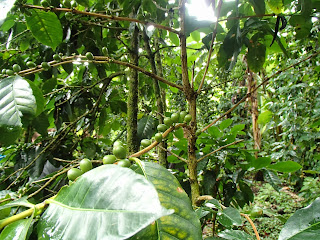
Coffee beans on the tree!

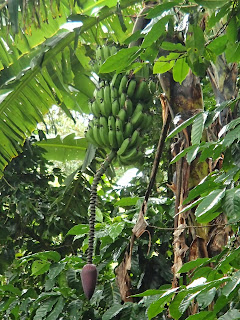
A banana tree (Musa acuminata)

A Trigona bee nest in a Ficus tree on the farm

A view of part of the farm... Can you tell?

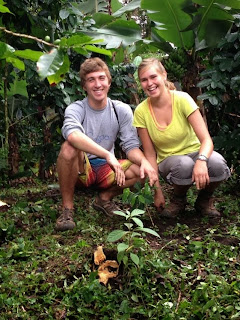
I got to plant a coffee tree!

After we had walked around the farm a bit and sampled all the crops, we looked at how the beans were shelled, washed, and dried.  They were then stored for up to a year before roasting and sold shortly after that for maximum flavor.  The farm here also harvests and processes sugar cane.  (If you know me you know how much I like sugar…)  I thoroughly enjoyed this part of the tour.
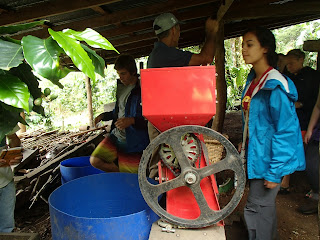
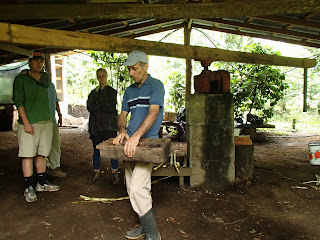
Hand crank to shell the ripe coffee beans

Mechanism used to juice the sugar cane!
And yes I ran around in a circle to help.

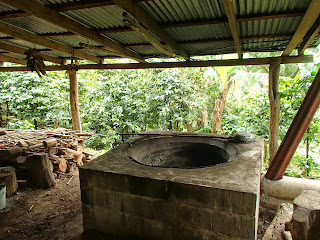
The sugar juice would then be boiled in this
large vat to condense the sugar into syrup.

Eugenio explaining how the syrup is then put into a mold
and dried to form blocks of delicious sugar.

All the forms of sugar that I sampled...
Sugar juice, sugar blocks, and straight up sugar cane!

After our interesting and fun tours we went back to the classroom to learn all of the school related stuff that I’m supposed to know…

Here is a general synthesis of the environmental, economic, and societal issues related to coffee production adapted from an assignment for school (so that I can validate in this post that I actually learned something other than how to make coffee), however my brain is too tired at present to synthesis this into an informative but less academic script.

Like many agricultural commodities in the 21st century, coffee production is closely tied with the environment, economy, and society of local and global populations.  Introduced to Costa Rica in the early 1800s, production has since expanded and become a sizable part of Costa Rica’s economy, representing the third most profitable cash crop for Costa Rica with nearly 82 million kilograms of coffee exported in 2007 alone (International Coffee Organization). The environmental impacts of coffee production range from soil erosion to excessive pesticide use and water pollution, though these impacts could be minimized through better management and sustainable business practices (Clay, 2004).  Additionally, many people were forced into impoverished situations following the crash in global market coffee prices caused by overproduction and deregulation of the coffee industry.

Coffee is just one of the many food items that can be added to an ever growing list of environmental and societal mishaps.  While work is being done to improve labor conditions and wages across the world through Free Trade and other initiatives, and environmental impacts are starting to be taken into account with organic and sustainable growing practices, real change is yet to be seen.  Deforestation remains an issue, with higher yield and shade grown alternatives slowly climbing in popularity.  These methods however are rarely profitable to the farmer, and are not economically sustainable to large monocultures (Niesten et al, 2004).

It is no surprise that areas of great biodiversity coincide with areas exhibiting impeccable agricultural potential.  Year round temperatures minimally fluctuate and copious rainfall in many areas provide optimal conditions for productivity, promising success for monocultures throughout the tropics.  Many countries in the tropics are built heavily, if not solely, on an agricultural economy.  But despite the hopes for high yield and agricultural success, many farmers still remain in poverty.  The export dependence of these commodity crops (such as cocoa and coffee) is extremely high for many tropical countries ranging from 55% for Brazil to 95% for Sri Lanka (Talbot, 2002).  High dependency on one or few crops can quickly lead to an unstable economy as the global supply and demand of these crops fluctuates.  Given the nature of commodity crops, they are often the first foods to crash when the global economy is struggling.  In times of economic hardship, demand for cocoa or coffee may drop significantly, while demand for corn, soy, or wheat may remain relatively stable.  The boom-and-bust nature of these commodity crops has left the farmers of many tropical countries struggling to rise out of impoverished situations.  A surplus of crop is often planted in times of economic depression in an effort to raise profits through quantity produced, consequently compounding the issues of deforestation and overproduction and lowering the price of coffee further (Clough, 2009). 

It is evident that given these situations, the social implications of coffee production are dismal at best.  Historically speaking, individual farmers have suffered while large monocultures profit at the expense of their laborers.  A long line up of steps between the third world farmer and the first world consumer, with each check point keen on making money, results in less income for the farmer and profits congregated in the developed world (Nelson, 2000).  Many farmers feel dependent on coffee due to lack of any other economic alternative, and their livelihoods are based on an industry that fails to meet their basic needs.  Farmers around the world depend on a trade that earns less than $2 per day (Houston, 2012).

The culmination of environmental, economic, and societal crisis in the coffee industry calls for the need of drastic reform focused on reducing deforestation of tropical ecosystems, diversification of commodity crop-based economies in tropical countries, and reducing the dependence of individual farmers and families on crop production.  While change is yet to be made, strategies are being developed and tested around the world in the hope of lowering environmental degradation and biodiversity loss while improving lives around the world.


Ok, now that we have that out of the way (no offense taken if you chose to skip over that last part) my day ended with Skype dates with friends, family, and last-but-not-least birthday cake!


References

Clay, J., 2004, World Agriculture and the Environment: A commodity-by-commodity guide to impacts and practices, Island Press.

Clough, Y., Faust, H., Tscharntke, T., 2009,  “Cacao boom and bust: sustainability of agroforests and opportunities for biodiversity conservation,” Conservation Letters 2 (2009): 197-205.

Gooding, K., Sweet like chocolate?  Making the coffee and cocoa trade work for biodiversity and livelihoods, The Royal Society for the Protection of Birds.

Houston, H., Wyer, T., 2012, “Why sustainable cocoa farming matters for rural development,” Center for Strategic and International Studies [online] http://csis.org/publication/why-sustainable-cocoa-farming-matters-rural-development

McMillan, M., Masters, W., 2000, “Understanding the political economy of agriculture in the tropics,” American Journal of Agricultural Economics 82: 738-742.

Nelson, V., Galvez, M., Social impact of ethical and conventional cocoa trading on forest-dependent people in Ecuador, Natural Resources and Ethical Trade Programme.

Niesten, E., Rice, R., Ratay, S., Paratore, K., 2004, “Commodities and Conservation: The need for greater habitat protection in the tropics,” Conservation International: Center for Applied Biodiversity Science.

Talbot, J., (2002), “Tropical commodity chains, forward integration strategies and internalional inequality: coffee, cocoa, and tea,” Review of International Political Economy 9:4 (November): 701-734.

Sunday, September 15, 2013

Guanacaste

This God – his way is perfect; the promise of the LORD proves true; he is a shield for all who take refuge in him.
~Psalm 18:30

After camping for a week in the jungle, I more resembled a prune than any other fruit.  All of my clothes were dirty or wet, and my legs were covered in bug bites.  I had hope that clothes would soon dry out at our next camping spot, as we were heading north to a dry forest.  However the name is deceiving.  Apparently ‘dry forest’ insinuates that there is a ‘dry season’ and September is not that season.  According to one of our instructors, this was the second rainiest camping week in the last 16 years or something like that.  I cannot believe how much it rained. 

We were fortunate to stay the night in a really nice (by camping comparisons) hotel the night between our two weeks in the national parks.  This gave me a chance to dry out a few clothes and go for a run on the beach.  However this proved to be more of an evil tease than anything else.  Getting back in the camping mindset after that was not so much fun…

Touristy hotel with a pool and pineapple drinks and a beach!

Our camping spot for this week in Santa Rosa National Park was more like the typical camping I am used to.  Surrounded by trees, some tarps strung up for shelter, even the forest reminded me of home.  Unlike the lowland wet forest, the lowland dry forest is deciduous, and looses leaves during the dry season.  Many of the plants looked like they could have been plucked straight from a New England temperate forest.  Heather and I set up our tent on the highest ground we could find, but after the first rain it appeared like even that would not be enough. 

It rained so hard, for so long, that I didn’t even think it was possible for the sky to hold that much water.  Our campground shelter soon became part of a river, and sporadic lightening illuminated the lake of the rest of our camping area.  And still it rained more.  Thank goodness there is some Calvin and Hobbes comic relief for every situation.


The first night we were there we went on a night hike to search for frogs.  We found a few different species, as well as a turtle and a viper!  None of us were too pleased with the idea of walking around in the rain (again) so soon, but after we got over that we had a great walk!  And on the bright side we  had a lantern (because it’s bright…)  After the viper sighting I was a little apprehensive to go to the bathroom in the middle of the night…


While at Santa Rosa we went on a hike to see the volcanoes, however it was too cloudy for an actual view.  We also studied the species abundant in the area, and did another field research project.  My group’s project involved the acacia tree (Vachellia collinsi) and the ants (Pseudomyrmex spp.) associated with it.  The two species exist in obligate mutualism; the ants can’t live without the tree, and the tree can’t live without the ants.  The ants provide protection from herbivory to the tree and the tree provides domatia and nourishment through extra floral nectaries and Beltian bodies (deposits of lipids and protein at the ends of the leaf).  Our study was to determine if healthier trees we home to more aggressive ant colonies, or if different species of Pseudomyrmex ants were more aggressive than others.  To measure aggressiveness, we found a spot on a branch and counted the number of ants that crossed an imaginary line in one minute.  We then tapped the branch a few times to aggravate the colony and mimic a predator, and counted the number of ants that crossed the same imaginary line in the next minute.  The difference represented a measure of aggressiveness.


Branch before

Branch after

One day while we were there we went on a 22km hike to a beach.  The most exciting part of the hike was finding a crocodile on a bridge that we had to cross, except half the bridge was washed out.  When the crocodile saw us, it jumped into the water that we had to wade through to get to the other half of the bridge…  Here are a couple pictures from the hike!


La playa

View from a look out point

We saw lots of animals during our time in Guanacaste.  Here are just a few of them.

Odocoileus virginianus
Deer are smaller in the tropics because they
don't need as much mass to stay warm.

Ctenosaura similis

Boa constrictor
(AHHHH!!!!!)

Cebus capucinus

A super tiny leaf litter frog I found in a puddle outside of my tent.
(At least the puddle was not inside my tent...)

Glossophaga soricina

Hypopachus variolosus that I found in my tent!

Our last day in Guanacaste we went to a nice little beach and played around in the waves.   At one point I left the group and went for a nice walk down the beach by myself.  On my way back I found a pufferfish!  This was definitely the highlight of the week.  I found it on the beach gasping for breath, so I picked it up and brought it back to the ocean.  Then it puffed all up and bobbed around for a while, so I picked it up again and ran it back to where every one was gathered to show them!  They told me to throw it way out to sea so that it wouldn’t be washed back on shore again, but throwing a pufferfish kind of hurts your hands…  In the end we had to leave it bobbing in the ocean and just hope for the best!


We watched the sunset together and then said goodbye to camping!  The next day we would head to Monteverde!